
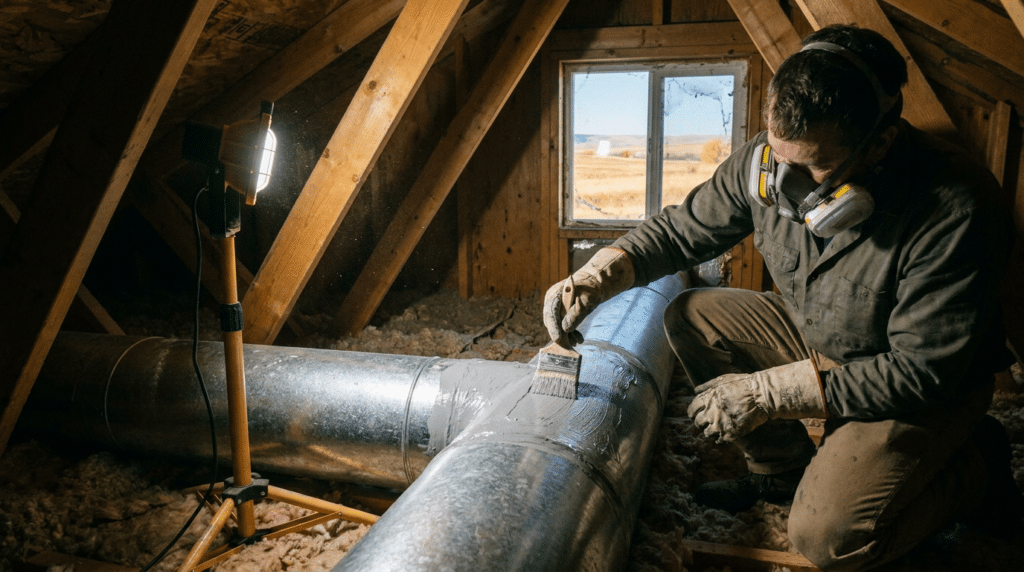
Air duct cleaning removes debris. Duct sealing addresses leaks, gaps, and disconnected sections. A home may need one service, both, or neither.
Treasure State Restoration provides professional duct cleaning throughout Southwest Montana. Call (406) 404-9826 to request an estimate.
Duct Cleaning and Duct Sealing Serve Different Purposes
Air duct cleaning focuses on material inside the ventilation system. Cleaning may be appropriate when an inspection finds substantial dust, construction debris, pest contamination, particles being released from supply registers, or verified microbial growth on cleanable surfaces.
Duct sealing focuses on the system’s physical condition. It may be recommended when duct sections have:
- Open seams or joints
- Loose connections
- Tears in flexible ductwork
- Gaps around boots, registers, or plenums
- Disconnected branch lines
- Openings between ducts and unconditioned spaces
- Failed tape or deteriorated sealing material
One service does not automatically require the other. A structurally sound system may need cleaning without sealing. A clean system may have significant leakage. Base the decision on what an inspection or appropriate diagnostic test finds.
Why Duct Leakage Matters
According to the U.S. Department of Energy, a typical home may lose 20% to 30% of the air moving through its duct system because of leaks, holes, and poorly connected sections.
The effect on a specific home depends on where the leakage occurs. Air escaping from ducts inside conditioned rooms may affect the home differently than air lost into an attic, garage, unfinished basement, or crawlspace.
Supply-side leaks allow conditioned air to escape before it reaches the intended rooms. Return-side leaks can draw air into the system from surrounding spaces.
Depending on the duct location, that unwanted air may contain:
- Dust
- Insulation particles
- Pest debris
- Musty odors
- Garage fumes
- Crawlspace air
- Excess moisture
- Outdoor particles
Duct leakage can also contribute to uneven temperatures and airflow imbalances. However, other issues can cause these problems, including dirty filters, undersized returns, closed registers, inadequate insulation, equipment faults, or poorly designed ductwork.
How Leaks Can Affect a Recently Cleaned System
Professional cleaning removes material already inside designated parts of the ventilation system. It does not repair damaged ductwork.
If return ducts have gaps in a dusty attic, crawlspace, or unfinished basement, the system may continue drawing particles from that area. Supply leaks can release conditioned air before it reaches the room it’s meant to serve.
That does not mean a cleaned system will immediately become contaminated again. The outcome depends on the size and location of the openings, surrounding conditions, filter performance, operating pressure, and how often the HVAC system runs.
If substantial contamination returns soon after cleaning, the system should be inspected for:
- Duct leakage
- Missing or poorly fitted filters
- Gaps around the filter rack
- Pest access
- Water intrusion
- Condensation
- Damaged duct insulation
- Uncontrolled renovation dust
- Contamination around return-air openings
Don’t repeat cleaning indefinitely without investigating why the material keeps returning.
How Duct Leakage Is Evaluated
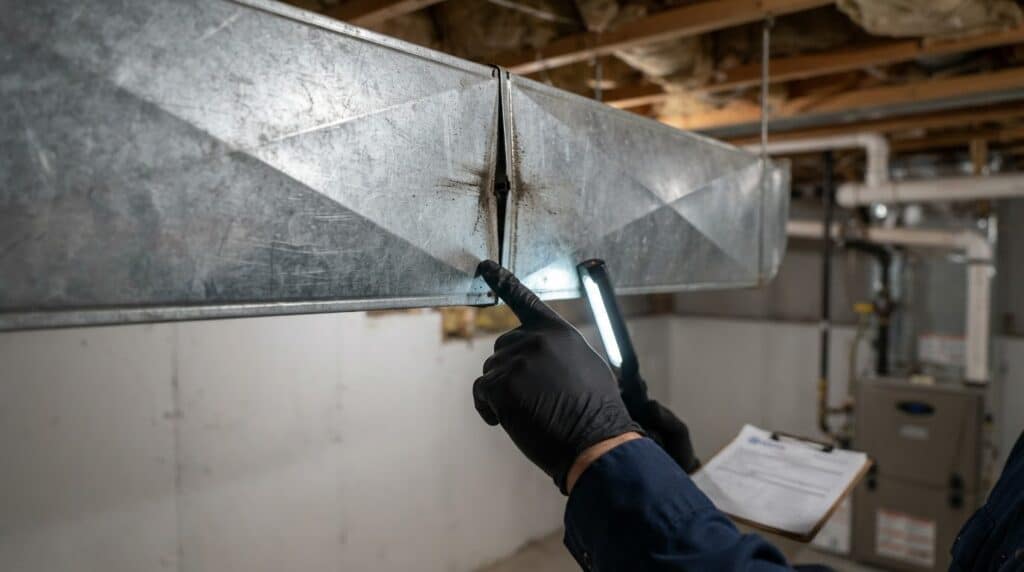
A visual inspection is a useful starting point, but much of a residential duct system may be hidden behind walls, ceilings, or finished surfaces.
A qualified professional may use one or more methods to evaluate the system.
Visual Inspection
A professional can check accessible ducts in attics, crawlspaces, garages, utility rooms, and unfinished basements for gaps, tears, crushed sections, disconnected runs, failed sealing materials, and damaged insulation.
Airflow Evaluation
Weak airflow at one register does not prove that a duct is leaking. However, differences between rooms may help identify sections that require closer inspection. You must also consider equipment condition, duct design, register position, and system balance.
Duct Leakage Testing
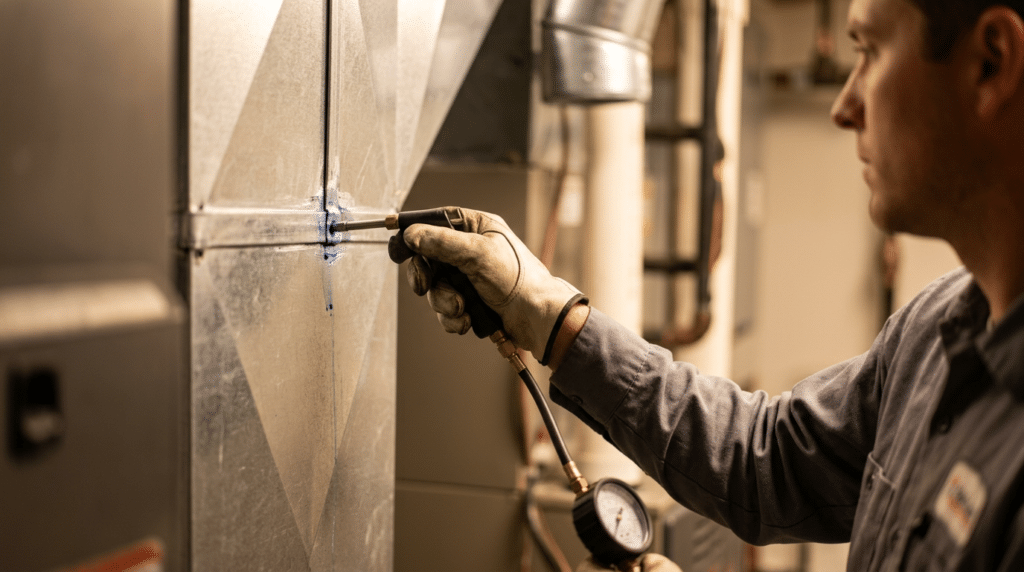
Specialized equipment can pressurize the duct system and measure overall leakage. Testing can help determine whether leakage is significant, but it may not locate every individual opening on its own.
Smoke or Air-Movement Testing
Approved smoke tools or other methods may help locate accessible leaks by showing air movement around seams and connections. Use these methods carefully and under appropriate conditions.
Combustion-Safety Review
Changes to duct pressure can affect homes with fuel-burning appliances. After significant duct repairs or sealing, a qualified professional may need to check airflow, pressure balance, and combustion safety.
Treasure State Restoration uses compressed air to clean ductwork. Ask which inspection steps are included in the cleaning scope and whether separate HVAC testing is needed.
Common Duct Sealing and Repair Methods
The appropriate method depends on the duct material, opening size, accessibility, and overall condition.
HVAC-Rated Mastic
Mastic is commonly applied to accessible duct joints and seams. It remains flexible after curing and is designed for HVAC applications.
Larger openings may require mesh reinforcement or physical repair before mastic is applied. Do not use mastic as a substitute for replacing collapsed or severely damaged ductwork.
Metal-Backed Foil Tape
UL-rated metal-backed tape may be appropriate for certain duct connections and repairs. Standard cloth-backed duct tape is not considered a durable duct-sealing material because its adhesive can dry out and fail.
Mechanical Reconnection
Disconnected sections must be properly reattached and supported before they are sealed. Covering a loose connection with tape or mastic does not correct inadequate fastening.
Repair or Replacement of Flexible Ductwork
Flexible ducts can become torn, crushed, kinked, unsupported, or disconnected. Damaged sections may require replacement rather than surface sealing.
Aerosol-Based Sealing
Some qualified HVAC contractors use aerosol-based systems to seal smaller leaks that are difficult to reach directly. This specialized service is not automatically appropriate for every system.
Before authorizing aerosol sealing, ask about:
- The product being used
- Contractor qualifications
- Preparation requirements
- Suitable duct materials
- Leakage measurements before and after work
- Occupancy precautions
- Manufacturer limitations
- Required HVAC or combustion-safety testing
Do not assume every duct-cleaning company offers aerosol sealing or other duct-repair services.
Duct Problems That Sealing Cannot Correct
Some conditions require repair, replacement, or redesign rather than additional sealant.
These include:
- Collapsed or crushed flexible ducts
- Severely deteriorated duct board
- Wet or mold-contaminated fiberglass duct liner
- Large holes or missing sections
- Inadequately supported duct runs
- Improperly sized supply or return ducts
- Poor system layout
- Insufficient return-air capacity
- Damaged insulation
- Ducts contaminated by an unresolved pest problem
- Condensation caused by missing insulation or other mechanical conditions
Wet or moldy porous duct material can be difficult to clean effectively and may require removal. You must also correct the moisture source, or the problem may return.
When contamination extends beyond the HVAC system, you may need separate mold remediation. If a leak, flood, or frozen pipe introduced water into the system, you may also need water-damage restoration.
Potential Benefits of Sealing Leaking Ductwork
When significant leakage is confirmed and repaired correctly, duct sealing may provide several benefits.
More Conditioned Air Reaching Intended Rooms
Reducing supply-side leakage may help deliver more heated or cooled air to the rooms served by those ducts.
It cannot guarantee that every room will reach the same temperature. Equipment sizing, insulation, windows, duct design, and register placement also affect comfort.
Reduced Entry of Air From Unconditioned Spaces
Sealing return-side leaks may reduce the chance of air from attics, crawlspaces, garages, or wall cavities entering the ventilation system.
This can be helpful when those spaces contain dust, insulation particles, odors, or other contaminants. Duct sealing does not eliminate every source of indoor air pollution or guarantee relief from respiratory symptoms.
Less Avoidable Heating and Cooling Loss
Conditioned air escaping into unconditioned spaces represents wasted heating or cooling. Repairing substantial leakage may reduce that loss.
Actual energy savings depend on leakage location and severity, equipment condition, insulation, climate, thermostat settings, utility rates, and household use. No contractor should promise a specific reduction without appropriate testing and calculations.
Improved Comfort in Some Rooms
Rooms receiving limited airflow because of a leaking or disconnected branch may become more comfortable after repair.
If the problem continues, the system may need balancing, equipment service, additional insulation, or a duct-design evaluation.
Better Control of Future Contamination
Sealing identified openings may reduce the amount of dust or debris entering through those points. Filters, moisture control, source removal, pest exclusion, and routine HVAC maintenance remain important.
Signs Your Duct System May Need Inspection
Schedule an inspection if you notice:
- Visible gaps, tears, or disconnected sections
- Flexible ducts that are crushed, kinked, or unsupported
- Air escaping from accessible seams
- Rooms that remain difficult to heat or cool
- Weak airflow from one or more registers
- Dust or debris entering around return-air openings
- Musty or unusual odors when the system operates
- Ducts in unconditioned areas with damaged insulation
- Unexpected heating or cooling use
- Contamination returning soon after professional cleaning
These conditions do not confirm duct leakage on their own. Dirty filters, blocked registers, equipment problems, poor insulation, damaged register boots, or inadequate system design can cause similar symptoms.
Dark streaks around a register may come from air moving through gaps between the register and surrounding drywall. They do not necessarily mean the entire duct system is dirty or disconnected.
What to Ask Before Authorizing Duct Sealing
Ask the contractor to explain:
- What evidence shows that the ducts are leaking
- Whether leakage was measured or visually observed
- Which sections require sealing
- Whether any ducts need repair or replacement first
- What materials will be used
- Whether the materials are rated for HVAC applications
- How accessible and concealed sections will be handled
- Whether airflow will be evaluated after the work
- Whether system balancing is included
- Whether combustion-safety testing is appropriate
- What results can realistically be expected
- Which services are included in the written estimate
Avoid contractors who promise 100% airflow delivery, guaranteed utility savings, complete allergen elimination, or permanent correction without inspecting the system.
Treasure State Restoration provides duct cleaning as part of its broader property restoration services. Ask the team whether a condition found during cleaning falls within its scope or should be referred to a qualified HVAC contractor.
Frequently Asked Questions
Should ducts be cleaned before sealing?
It depends on the system's condition. If substantial dust, pest debris, construction material, or other contamination is present, cleaning may be appropriate before certain sealing work begins. If the ducts are clean but leaking, you may seal them without cleaning first.
Can duct sealing lower my heating and cooling bills?
Repairing significant leaks may reduce avoidable conditioned-air loss, particularly when ducts run through attics, crawlspaces, garages, or unfinished basements. Actual savings vary and should not be guaranteed without evaluating the home and duct system.
Can duct sealing prevent dust from entering the HVAC system?
Sealing return-side leaks may reduce dust entering through identified gaps in unconditioned spaces. It cannot stop dust from entering through doors, windows, occupant activities, poorly fitted filters, or other indoor and outdoor sources.
Who should repair leaking or damaged ductwork?
A qualified HVAC contractor commonly handles duct testing, sealing, balancing, repair, and replacement. A duct-cleaning provider may identify visible defects during cleaning, but homeowners should confirm which services the company is qualified and equipped to complete.
The Bottom Line
Duct sealing is not an automatic final step after every air vent cleaning. Cleaning removes material from inside the ventilation system. Sealing corrects confirmed gaps, leaks, and damaged connections.
If contamination returns after cleaning, or if certain rooms have persistent airflow or temperature problems, arrange an inspection. Significant leakage, damaged insulation, disconnected ducts, equipment problems, and poor system design can produce similar symptoms and may require different solutions.
Treasure State Restoration provides professional duct cleaning throughout Bozeman, Belgrade, Four Corners, Manhattan, and surrounding Southwest Montana communities. Call (406) 404-9826 or request an estimate to discuss your duct-cleaning needs.
Related Reads
- Health Benefits of Residential Air Vent Cleaning
- Professional Duct Cleaning Services in Bozeman, MT
- Mold Remediation in Southwest Montana
- Water Damage Restoration in Bozeman, MT

- Does Renters Insurance Cover Fire Damage? What You Need to Know - November 18, 2026
- Preventing Damage to Your Home While You’re Away for the Holidays - November 18, 2026
- Health Benefits of Residential Air Vent Cleaning - November 17, 2026