
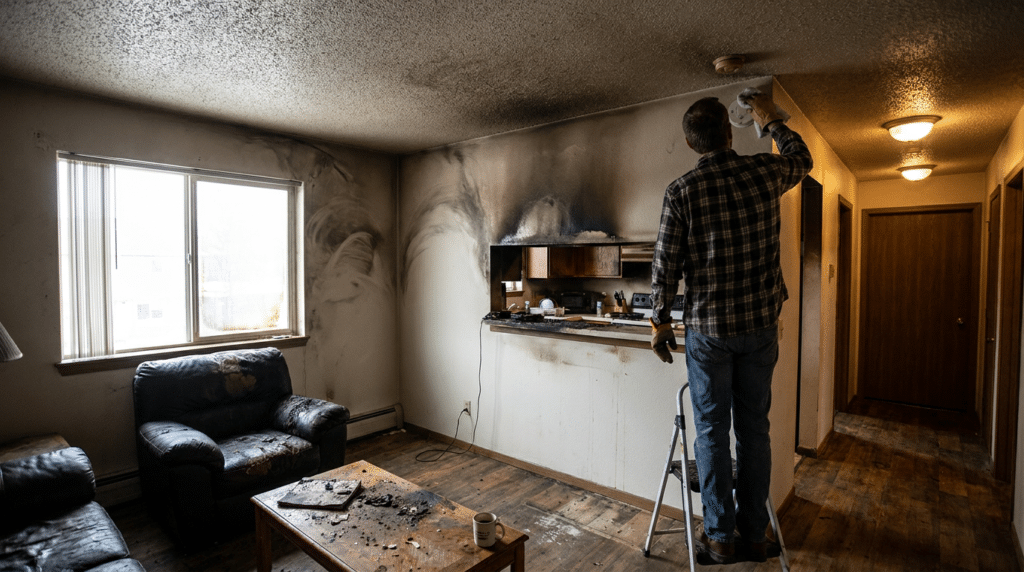
Yes, renters insurance typically covers personal belongings damaged by a covered fire, subject to the policy’s terms. It may also help with additional living expenses and certain liability claims. Your landlord’s insurance generally covers the building, not your possessions.
Separate Your Belongings From the Building
Your couch and the wall behind it usually belong in different insurance claims. Renter’s insurance generally protects your personal property against covered losses. The property owner’s policy generally addresses damage to the building and landlord-owned fixtures.
That distinction matters even when everything has the same smoke damage. A mattress you purchased belongs on your personal property inventory. Built-in cabinets usually belong in the property owner’s claim. Appliances, flooring, or improvements you purchased may require closer review, so tell the adjuster about them rather than guessing which policy applies.
A landlord’s policy is not a substitute for renters insurance. It generally does not insure a tenant’s possessions simply because they were inside the rental.
| Coverage | What It May Address | Evidence to Gather | Key Boundary |
|---|---|---|---|
| Renters personal property | Fire-damaged clothing, furniture, electronics, and other insured belongings | Inventory, photographs, purchase records, and damage assessments | Deductibles, exclusions, and item limits may reduce payment |
| Renters loss of use | Eligible additional living expenses when a covered loss makes the rental uninhabitable | Lodging and meal receipts, plus records of normal expenses | Expense limits, time limits, and covered reasons for displacement apply |
| Renters personal liability | Certain claims alleging that you caused fire damage or injured someone | Incident reports, demand letters, and communications about responsibility | Legal responsibility, exclusions, and coverage limits require separate review |
| Landlord building coverage | Covered damage to the structure and landlord-owned fixtures | Building inspection records, photographs, and repair estimates | Generally does not replace tenant-owned belongings |
Notify both your landlord and your insurer promptly. Their claims may proceed alongside yours, but neither should be treated as a replacement for the other.
Fire Damage Includes More Than Burned Items
Renters insurance may cover belongings damaged by smoke, soot, heat, or firefighting water when the damage results from a covered fire. Coverage remains subject to the policy’s limits, exclusions, deductible, and claim investigation.
Smoke can move beyond the room where a fire began. Clothing, furniture, electronics, and other belongings may be affected even when flames never touched them.
For example, smoke from a neighboring unit may affect clothing and soft goods while leaving furniture visibly intact. Photograph the room, list the affected items, and record visible residue or smoke odors. Report what you observe without deciding whether an item is ruined or safe to use.
Water used to suppress a covered fire may also become part of the claim. That does not mean all water damage is covered. Tell the insurer where the water came from so they can evaluate the correct cause of loss.
Cleaning Versus Replacement
A damaged item does not automatically qualify for replacement. The adjuster may consider whether professional cleaning or repair is appropriate. Material, heat exposure, residue, contamination, and the item’s intended use can all affect that decision.
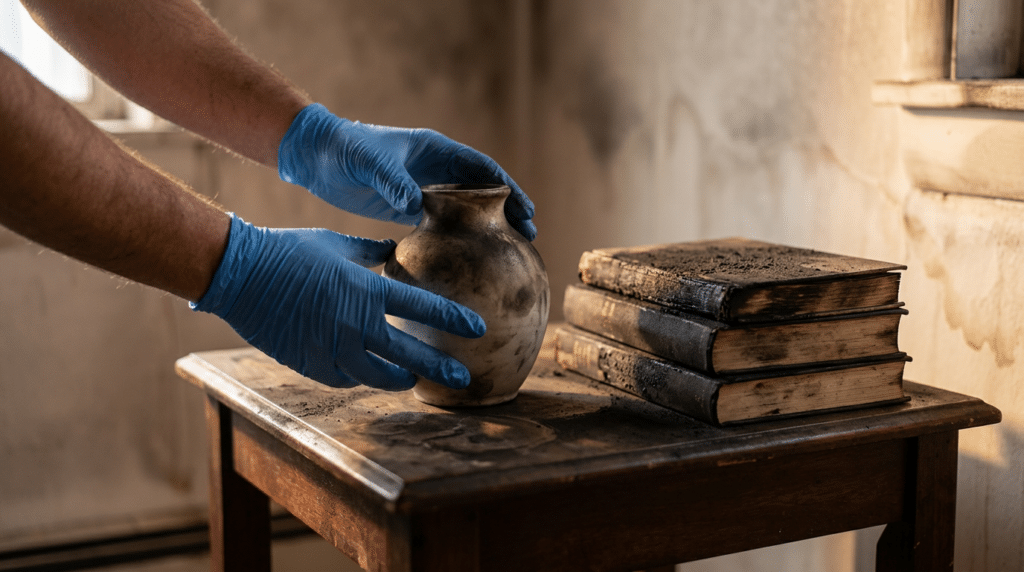
Avoid scrubbing soot or operating smoke-exposed electronics before an adjuster assesses them. Incorrect cleaning can spread residue, set staining, remove evidence, or cause additional damage.
When safe, keep affected belongings separate from clean items. Do not remain inside an unsafe property simply to move or photograph possessions.
Professional fire and smoke damage restoration answers a different question from insurance adjustment. The restoration assessment identifies what work the damage may require. The insurer separately determines which documented expenses qualify under the policy.
Your Settlement Starts With How Items Are Valued
How your policy values belongings can significantly affect your settlement after a covered fire. Look for actual cash value or replacement cost coverage in your policy documents.
Neither term means the insurer automatically pays the original purchase price or the cost of any replacement you choose.
Actual Cash Value Accounts for Age and Wear
Actual cash value generally reflects an item’s value after depreciation. Depreciation may account for age, wear, condition, and other relevant factors.
A used sofa may therefore receive a different valuation from the cost of purchasing a comparable new sofa.
Review the adjuster’s description of each item. An incorrect age, model, size, or condition can affect the calculation. Purchase emails, photographs, manuals, model numbers, and product records may support a correction.
Replacement Cost May Involve More Than One Payment
Replacement cost coverage generally bases eligible reimbursement on a comparable replacement, subject to the policy’s terms and limits.
Some policies initially pay a depreciated amount. Additional payment may require proof that you replaced the item within a specified period.
Ask how the process works before making large purchases. Keep every receipt and identify which damaged item each purchase replaces. Choosing an upgraded model does not necessarily make the full purchase price eligible.
Deductibles and Special Limits Still Apply
Your deductible is the portion of a covered loss assigned to you under the policy. Policy limits cap eligible payments, while special limits may apply to certain property types.
Review the policy carefully if your loss includes:
- Jewelry
- Firearms
- Collectibles
- Artwork
- Business equipment
- Cash
- Electronic equipment
- Other high-value property
These items may have lower sublimits or require scheduled coverage.
Temporary Housing Has Its Own Rules
Loss-of-use coverage may help with additional living expenses when a covered fire makes your rental uninhabitable. The focus is usually the increase over your normal household spending, not every expense incurred while living somewhere else.
For example, if you normally buy groceries, the insurer may compare your usual food spending with the added cost of meals during displacement.
Depending on the policy and circumstances, eligible expenses may include:
- Temporary lodging
- Increased meal expenses
- Laundry costs
- Pet boarding
- Additional transportation
- Moving or storage expenses
- Other necessary increases in normal living costs
Keep itemized receipts rather than relying only on card statements. Record why each expense was necessary and how it related to the displacement.
Before committing to a long-term hotel, rental, or other major expense, ask:
- Whether advance approval is required
- Which lodging options qualify
- Whether the insurer pays the provider or reimburses you
- What documentation is required
- What dollar limit applies
- How long the coverage lasts
- Whether any expenses are excluded
A mandatory evacuation without direct damage to your unit may require a separate review. Some policies include provisions for prohibited access or civil authority orders, but the wording and time limits vary.
Rent obligations are also separate from living-expense coverage. Your lease and applicable law may affect whether rent continues during displacement. Get the landlord’s position in writing instead of assuming the insurance claim automatically changes the lease.
Accidental Fires and Liability Need Separate Review
A policy may still cover your insured belongings after an accidental fire, even when questions arise about who caused it. Liability for damage to the building, another unit, or another person’s property requires a separate review.
A cooking fire, for example, could affect:
- Your belongings
- The landlord’s building
- A neighboring tenant’s possessions
- Shared hallways or utilities
- Someone who was injured
- Temporary housing for multiple households
Those losses involve different owners, policies, and coverage sections.
Give your insurer accurate facts without accepting blame, promising payment, or negotiating directly with another insurer. Forward demand letters, invoices, or reimbursement requests to your insurance company promptly.
Personal liability coverage may provide a defense or payment for qualifying claims. Damage to rented property can involve specific exclusions, exceptions, and fire legal liability provisions, so ask the insurer which policy language applies.
Intentional Damage Requires Different Review
Policies commonly exclude intentional loss caused by an insured. How the exclusion applies to other insured occupants or household members can depend on the wording and applicable law.
A fire intentionally set by someone else still requires a full claim review. Report what happened and provide any fire department, law enforcement, or incident records available.
Roommates May Need Their Own Coverage
Sharing an address does not automatically make every roommate an insured person under your policy. A policy may cover a spouse, relative, or another person only when specific definitions are satisfied.
Check who is named or qualifies as an insured before adding another person’s possessions to your inventory. A roommate may need to file under a separate renters policy.
Document the Loss Before Cleanup Changes It
Good documentation connects each damaged item to the fire and helps distinguish personal property from building damage.
Begin only after emergency officials permit access. Do not enter an unstable, smoke-filled, electrically unsafe, or otherwise hazardous property to collect evidence.
1. Open the Claim
Report the fire promptly. Save your claim number, adjuster’s name, telephone number, email address, and any initial instructions.
2. Notify the Property Owner
Tell your landlord or property manager about the damage. Coordinate access and identify who can authorize work involving the structure.
3. Photograph the Scene
When it is safe, capture:
- Wide views of each affected room
- Individual damaged items
- Product labels and model numbers
- Visible soot and smoke residue
- Heat damage
- Firefighting water
- Damage extending into adjoining rooms
- Items that must be moved or discarded
4. Create a Personal Property Inventory
For each item, record:
- Description
- Brand and model
- Approximate purchase date
- Original purchase price, if known
- Condition before the fire
- Type of damage
- Current location
- Whether it was cleaned, stored, discarded, or replaced
Missing receipts do not mean you should leave an item off the inventory. Older photographs, online order histories, manuals, bank records, product registrations, and model numbers may help establish ownership and value.
Do not invent precise details you cannot support. Mark approximate dates and amounts as estimates.
5. Preserve Supporting Records
Save:
- Fire department reports
- Incident records
- Purchase emails
- Bank or card records
- Restoration assessments
- Cleaning estimates
- Replacement estimates
- Temporary housing records
- Expense receipts
- Communications with the landlord
- Communications with the insurer
6. Track Disposal and Cleaning Decisions
Ask before discarding damaged property whenever practical and safe. If health or safety conditions require immediate disposal, photograph the item and document why you could not retain it.
Do not keep hazardous property solely for an insurance claim.
7. Protect the Property From Additional Damage
Your policy may require reasonable steps to limit further damage. Emergency protection can include securing openings, removing standing water, or separating affected items when safe to do so.
Coordinate urgent work with the landlord and insurer, but don’t delay action needed to protect people or prevent additional property damage.
A Restoration Estimate Is Not a Coverage Decision
A restoration estimate describes proposed work and its expected cost. It does not determine what an insurance policy covers.
Keep these separate:
- The contractor’s assessment of the damage
- The insurer’s coverage decision
- The landlord’s responsibility for the building
- The tenant’s responsibility for belongings
- The work authorization
- Responsibility for costs the insurer does not pay
Treasure State Restoration provides free fire and smoke damage inspections and helps document restoration work for insurance claims. Our team prepares photographs, moisture documentation, project records, and Xactimate scopes to support communication about the damage and proposed restoration.
Treasure State Restoration is an IICRC-certified firm. Our work follows recognized restoration practices for inspection, cleaning, drying, and property recovery.
Firefighting Water Needs Its Own Assessment
Water used to suppress a fire can move into walls, flooring, ceilings, insulation, and adjoining rooms.
Water-damage restoration may be needed alongside smoke and soot cleanup. Moisture mapping uses readings across affected materials to identify wet areas. Extraction removes accessible liquid water, while dehumidification removes moisture from the air to support drying.
Repeated readings help guide drying decisions. A surface that looks or feels dry does not confirm that the inside of a wall or floor has reached an appropriate moisture level.
Drying timelines vary based on:
- The amount of water
- Materials affected
- Water contamination
- Indoor temperature
- Relative humidity
- Access to hidden areas
- How long materials remained wet
If moisture remains unresolved, you may need separate mold remediation.
Agree on Authorization and Payment
Read the work authorization before signing. Identify:
- Who is hiring the contractor
- Which work is being approved
- Who owns the affected property
- Who can authorize building demolition
- How insurance payments will be handled
- Who is responsible for unpaid balances
- How changes to the scope will be approved
A tenant should not assume authority to approve demolition or permanent repairs to the landlord’s building.
A free inspection is separate from paid restoration work. Direct insurance billing does not guarantee coverage or relieve the customer of contractual obligations.
If uncovered costs remain, restoration financing may be available to qualifying customers. Financing approval and terms are determined separately from the insurance claim.
Flood, Sewage and Other Water Losses Require Separate Review
Fire coverage should not be used to predict coverage for every type of water damage. Insurers evaluate the cause of loss, even when the resulting damage looks similar.
Firefighting Water
Water used to suppress a covered fire may be evaluated as part of the fire loss. Document where it entered, which belongings were affected, and what emergency drying was required.
Outside Floodwater
Standard renters insurance generally does not cover damage caused by outside flooding. Renters can purchase separate contents coverage through the National Flood Insurance Program or another flood insurer.
A landlord’s building flood policy does not ordinarily cover a tenant’s personal belongings.
Sewage Backup
Sewage backup coverage may require a specific endorsement, which is an amendment added to the policy. It may also have a separate limit, deductible, or exclusion.
Do not rely on general water-damage wording. Ask whether the policy includes coverage for sewer or drain backup and what conditions apply.
Plumbing and Appliance Leaks
Sudden water damage from a plumbing or appliance failure may be evaluated differently from gradual leakage, groundwater, flooding, or sewage backup.
Record the apparent source and when you discovered the damage. Let the insurer determine which policy provision applies.

Frequently Asked Questions
How long does fire and smoke damage restoration take?
The timeline depends on the affected materials, soot and smoke residue, water damage, access, contents, and repairs required. Water left by firefighting can add extraction and drying work. Ask for a project schedule based on the inspection findings, and keep that timeline separate from insurance review and temporary-housing limits.
Does renters insurance cover belongings damaged by a neighbor’s fire?
A renters policy may cover insured belongings damaged by smoke, heat, soot, or firefighting water from a neighboring fire when the loss falls within the policy’s coverage. You generally do not need to establish the neighbor’s fault before reporting your own loss. Your insurer can review coverage and any recovery from another responsible party separately.
What should I do if the insurer disputes the cleanup estimate?
Request the insurer’s explanation in writing. Compare the disputed work with photographs, inspection findings, measurements, and item descriptions. Ask the restoration contractor to explain why each task is recommended. If the disagreement concerns coverage, request the applicable policy language and information about the insurer’s review or appeal process.
Can Treasure State Restoration help document fire damage for my claim?
Yes. Treasure State Restoration offers free fire and smoke damage inspections and helps document restoration work for insurance claims. Our team can prepare project records and explain the work reflected in an estimate. Your insurer determines coverage under the issued policy.
The Bottom Line
- Separate the claims. Your belongings, the building, additional living expenses, and liability involve different coverage questions.
- Document before disposal. Photographs, inventories, receipts, and written instructions may support the review of damaged property.
- Read the payment terms. Valuation methods, deductibles, special limits, and replacement deadlines affect eligible reimbursement.
- Assess before replacing. Professional inspection may identify which belongings can be cleaned and which materials require removal or replacement.
- Do not delay emergency protection. Take reasonable, safe steps to prevent additional damage while coordinating with the landlord and insurer.
A documented assessment gives you a practical starting point for discussing the damage with your landlord, restoration contractor, and adjuster.
Treasure State Restoration provides 24/7 emergency response and free fire and smoke damage inspections throughout Bozeman, Belgrade, and Southwest Montana. Call (406) 404-9826 or request an inspection.
This article provides general information and does not interpret any specific insurance policy or lease. Coverage depends on the issued policy, endorsements, exclusions, limits, cause of loss, and insurer’s investigation. Ask your insurer, licensed insurance professional, or attorney about your circumstances.
Related Reads
- Fire and Smoke Damage Restoration
- Water Damage Restoration
- Mold Remediation
- Complete Damage Restoration Services

- Does Renters Insurance Cover Fire Damage? What You Need to Know - November 18, 2026
- Preventing Damage to Your Home While You’re Away for the Holidays - November 18, 2026
- Health Benefits of Residential Air Vent Cleaning - November 17, 2026